Beauveria
Three species are recognised, two of which are well known pathogens of insects.
Beauvaria bassiana is the most common species and is best known as the causal agent of muscardine disease in silkworms. Beauveria species are occasionally isolated in the clinical laboratory as saprophytic contaminants, although rare human cases of keratitis have been reported (Lara Oya et al., 2016).
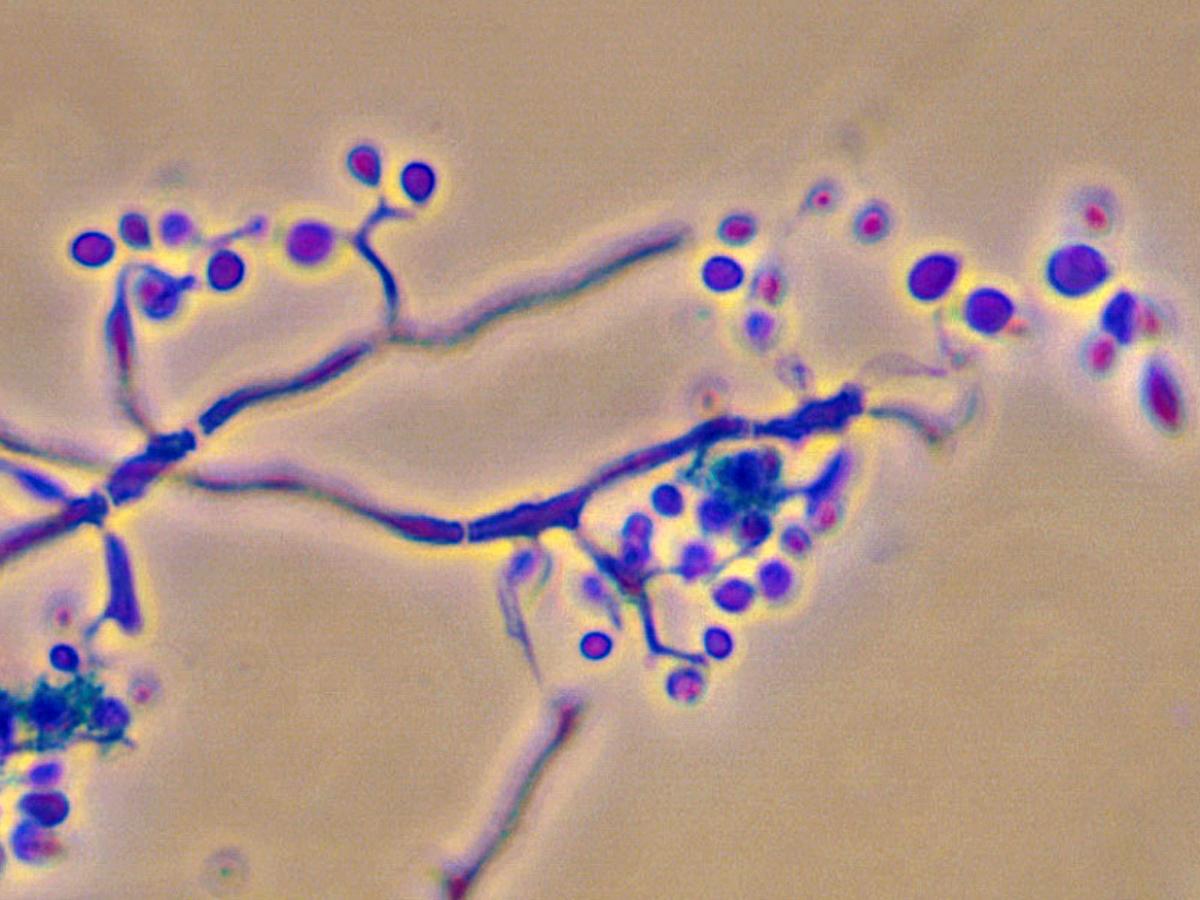
Beauvaria bassiana showing sympodial development of conidia on a geniculate or zig-zag rachis. Conidiogenous cells are flask-shaped, rachiform, proliferating sympodially and are often aggregated into sporodochia or synnemata. Conidia are hyaline and globose or ovoid in shape.
RG-1 organism.
Morphological description:
Colonies are usually slow growing, usually not exceeding 2 cm in ten days at 20C, downy, at first white, but later often becoming yellow to pinkish. The genus Beauveria is characterised by the sympodial development of single-celled conidia (ameroconidia) on a geniculate or zig-zag rachis. Conidiogenous cells are flask-shaped, rachiform, proliferating sympodially and are often aggregated into sporodochia or synnemata. Conidia are hyaline and globose or ovoid in shape.
Key features:
Hyphomycete showing sympodial development of single-celled conidia on a geniculate or zig-zag rachis emanating from a flask-shaped conidiophore.
Molecular identification:
Specific primers were developed by Hegedus and Khachatourians (1996). Full phylogeny of the genus was provided by Rehner and Buckley (2005). Biogeography of molecular types was characterised by Ghikas et al. (2010).
MALDI-TOF MS:
Cassagne et al. (2011) published a standardised procedure for mould identification in the clinical laboratory.
References:
- Cassagne, C., Ranque, S., Normand, A.C., et al. (2011) Mould routine identification in the clinical laboratory by matrix-assisted laser desorption ionization time-of-flight mass spectrometry. PLoS One, 6, e28425.
- de Hoog, G.S. (1972) The genera Beauvaria, Isaria, Tritrachium and Acrodontium gen. nov. Studies in Mycology, 1, 1-41.
- de Hoog, G.S., Guarro, J., Gene, J., et al. (2015) Atlas of Clinical Fungi (Version 4.1.2). Centraalbureau voor Schimmelcultures, Utrecht, The Netherlands.
- Domsch, K.H., Gams, W. and Anderson, T.H. (2007) Compendium of soil fungi. Second Edition, IHW-Verlag, Germany.
- Ghikas, D.V., Kouvelis, V.N. and Typas, M.A. (2010) Phylogenetic and biogeographic implications inferred by mitochondrial intergenic region analyses and ITS1-5.8S-ITS2 of the entomopathogenic fungi Beauveria bassiana and B. brongniartii. BMC Microbiology, 10, 174.
- Hegedus, D.D. and Khachatourians, G.G. (1996) Identification and differentiation of the entomopathogenic fungus Beauveria bassiana using polymerase chain reaction and single-strand conformation polymorphism analysis. Journal of Invertebrate Pathology, 67, 289-299.
- Kidd, S., Halliday, C., Ellis, D. (2023) Descriptions of Medical Fungi (4th edition). CABI.
- Lara Oya, A., Medialdea Hurtado, M.E., Rojo Martín, M.D., et al. (2016) Fungal keratitis due to Beauveria bassiana in a contact lenses wearer and review of published reports. Mycopathologia, 181, 745-752
- McGinnis, M.R. (1980) Laboratory handbook of medical mycology. Academic Press, New York.
- Rehner, S.A. and Buckley, E. (2005) A Beauveria phylogeny inferred from nuclear ITS and EF1-alpha sequences: evidence for cryptic diversification and links to Cordyceps teleomorphs. Mycologia, 97, 84-98.