Cylindrocarpon
The genus contains 35 species, mostly from soil and as an occasional human and animal pathogen.
Cylindrocarpon differs from Fusarium by lacking an asymmetrical foot-cell on the macroconidia.
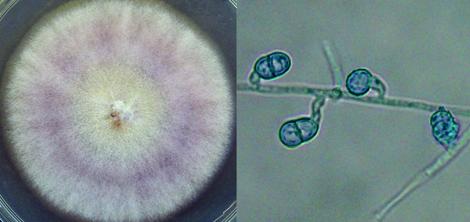
Culture and chlamydospores of Cylindrocarpon spp.
RG-2 organism (if isolated from humans).
Morphological description:
Colonies are fast growing, hyaline or bright-coloured, suede-like or woolly. Sporodochia may occasionally be present. Conidiophores consist of simple or repeatedly verticillate phialides, arranged in brush-like structures. Phialides are cylindrical to subulate, with small collarettes producing hyaline, smooth-walled conidia, arranged in slimy masses. Two types of conidia may be produced: (1) macroconidia which are one to several septate, hyaline, straight or curved, cylindrical to fusiform, with a rounded apex and flat base; and (2) microconidia which are one-celled, and usually clearly distinct from the macroconidia. Chlamydospores may be present or absent, hyaline to brown, spherical, formed singly, in chains or in clumps, intercalary or terminal.
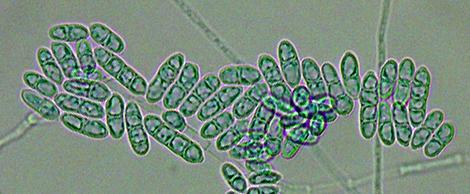
Macroconidia of Cylindrocarpon spp
References:
- Booth, C. (1966) The genus Cylindrocarpon. Commonwealth Mycological Institute, Mycological Papers, 104, 1-56.
- de Hoog, G.S., Guarro, J., Gene, J., et al. (2015) Atlas of Clinical Fungi (Version 4.1.2). Centraalbureau voor Schimmelcultures, Utrecht, The Netherlands.
- Domsch, K.H., Gams, W. and Anderson, T.H. (2007) Compendium of soil fungi. Second Edition, IHW-Verlag, Germany.
- Kidd, S., Halliday, C., Ellis, D. (2023) Descriptions of Medical Fungi (4th edition). CABI.
- Summerbell, R.C. and Schroers, H.J. (2002) Analysis of phylogenetic relationship of Cylindrocarpon lichenicola and Acremonium falciforme to the Fusarium solani species complex and a review of similarities in the spectrum of opportunistic infections caused by these fungi. Journal of Clinical Microbiology, 40, 2866-2875.