Epicoccum nigrum
Synonym:
Epicoccum purpurascens
Epicoccum nigrum is a cosmopolitan saprophyte of worldwide distribution which is occasionally isolated as a contaminant from clinical specimens like skin.
RG-1 organism.
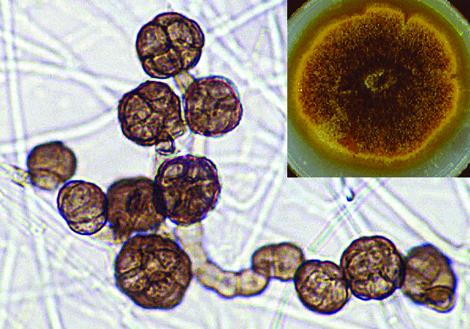
Culture and conidia of Epicoccum nigrum.
Morphological description:
Colonies are fast growing, suede-like to downy, with a strong yellow to orange-brown diffusible pigment. When sporulating, numerous black sporodochia (aggregates of conidiophores) are visible. Conidia are formed singly on densely compacted, non-specialised, determinant, slightly pigmented conidiophores. Conidia are globose to pyriform, mostly 15-25 µm diameter with a funnel-shaped base and broad attachment scar, often seceding with a protuberant basal cell; i.e. aleuric or rhexolytic dehiscence of conidia. Conidia become multicellular (dictyoconidia), darkly pigmented and have a verrucose external surface.
Key features:
Dematiaceous hyphomycete producing darkly pigmented, large globose to pyriform, verrucose dictyoconidia on a sporodochium.
References:
- Domsch, K.H., Gams, W. and Anderson, T.H. (2007) Compendium of soil fungi. Second Edition, IHW-Verlag, Germany.
- Ellis, M.B. (1971) Dematiaceous hyphomycetes. Commonwealth Mycological Institute, Kew, Surrey, England.
- Kidd, S., Halliday, C., Ellis, D. (2023) Descriptions of Medical Fungi (4th edition). CABI.
- Samson, R.A., Hoekstra, E.S., Frisvad, J.C., et al. (1995) Introduction to food-borne fungi. Centraalbureau voor Schimmelcultures, P.O.Box 273, 3740 AG BAARN, The Netherlands.