Exserohilum
The genus Exserohilum contains about 35 species and may be differentiated from the closely related genera Bipolaris and Dreschlera by forming conidia with a strongly protruding truncate hilum (i.e. exserted hilum).
In Drechslera species, the hilum does not protrude; in Bipolaris species the hilum protrudes only slightly. Several species of Exserohilum have been reported as agents of phaeohyphomycosis, notably E. rostratum, E. mcginnisii and E. longirostratum. Although recent molecular studies have demonstrated that the latter two species are probable synonyms of E. rostratum (de Cunha et al. 2012b, Katragkou et al. 2014). E. rostratum was recently implicated in an outbreak of fungal meningitis associated with contaminated methylprednisolone in the United States (Smith et al., 2013). Human infections mainly come from warm, tropical and subtropical locations such as southern United States, India and Israel (Adler et al., 2006)..
Exserohilum rostratum
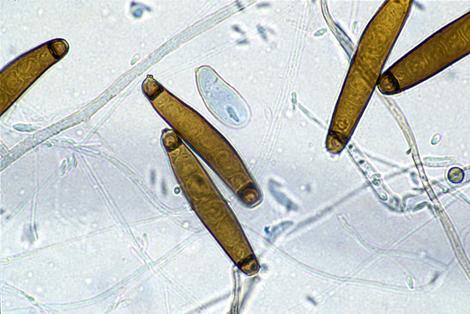
Conidia of Exserohilum rostratum.
RG-1 organism.
Morphological description:
Colonies are grey to blackish-brown, suede-like to floccose in texture and have an olivaceous-black reverse. Conidia are straight, curved or slightly bent, ellipsoidal to fusiform and are formed apically through a pore (poroconidia) on a sympodially elongating geniculate conidiophore. Conidia have a strongly protruding, truncate hilum and the septum above the hilum is usually thickened and dark, with the end cells often paler than other cells, walls often finely roughed. Conidial germination is bipolar.
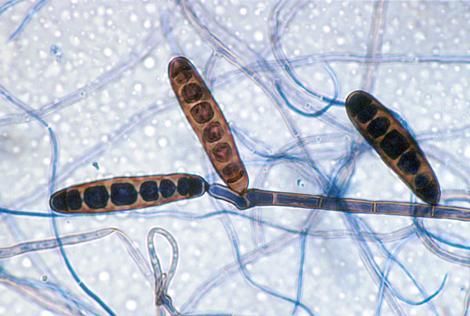
Sympodially elongating conidiophore and conidia of Exserohilum rostratum.
Key features:
Dematiaceous hyphomycete producing sympodial, transverse septate, ellipsoidal to fusiform conidia with dark bands on both ends and a strongly protruding, truncate hilum.
Molecular identification:
ITS and D1/D2 sequencing is recommended.
| Antifungal susceptibility: Exserohilum rostratum (Australian national data); MIC µg/mL | |||||||||||
|---|---|---|---|---|---|---|---|---|---|---|---|
| No | ≤0.016 | 0.03 | 0.06 | 0.125 | 0.25 | 0.5 | 1 | 2 | 4 | ≥8 | |
| AmB | 31 | 4 | 5 | 6 | 7 | 6 | 2 | 1 | |||
| ISAV | 7 | 2 | 4 | 1 | |||||||
| VORI | 31 | 1 | 2 | 4 | 12 | 10 | 2 | ||||
| POSA | 29 | 6 | 1 | 5 | 11 | 6 | |||||
| ITRA | 31 | 4 | 11 | 12 | 3 | 1 | |||||
References:
- Adam, R.D., Paquin, M.L., Petersen, E.A., et al. (1986) Phaeohyphomycosis caused by the fungal genera Bipolaris and Exserohilum. A report of 9 cases and review of the literature. Medicine, 65, 203-217.
- Adler, A., Yaniv, I., Samra, Z., et al. (2004) Exserohilum: an emerging human pathogen. European Journal of Clinical Microbiology and Infectious Diseases, 25, 247-253.
- Alcorn, J.L. (1983). Genetic concepts in Drechslera, Bipolaris and Exserohilum. Mycotaxon, 17, 1-86.
- Burges, G.E., Walls, C.T. and Maize, J.C. (1987). Subcutaneous phaeohyphomycosis caused by Exserohilum rostratum in an immunocompetent host. Archives of Dermatology, 123, 1346-1350.
- da Cunha, K.C., Sutton, D.A., Gene, J., et al. (2012). Molecular identification and in vitro response to antifungal drugs of clinical isolates of Exserohilum. Antimicrobial Agents and Chemotherapy. 56, 4951-4954.
- de Hoog, G.S., Guarro, J., J. Gene, J., et al. (2020) Atlas of clinical fungi. 4th edition. Foundation Atlas of Clinical Fungi https://webshop.atlasclinicalfungi.org.
- Dixon, D.M. and Polak-Wyss, A. (1991) The medically important dematiaceous fungi and their identification. Mycoses, 34, 1-18.
- Domsch, K.H., Gams, W. and Anderson, T.H. (2007) Compendium of soil fungi. Second Edition, IHW-Verlag, Germany.
- Hernandez-Restrepo, M., Maid, H., Tan, Y., et al. (2018) Multi-locus phylogeny and taxonomy of Exserohilum. Persoonia, 41, 71-108.
- Katragkou, A., Pana, Z.D., Perlin, D.S., et al. (2014) Exserohilum infections: review of 48 cases before the 2012 United States outbreak. Medical Mycology, 52, 376-386.
- Kidd, S., Halliday, C., Ellis, D. (2023) Descriptions of Medical Fungi (4th edition). CABI.
- McGinnis, M.R., Rinaldi, M.G. and Winn, R.E. (1986) Emerging agents of phaeohyphomycosis: pathogenic species of Bipolaris and Exserohilum. Journal of Clinical Microbiology, 24, 250-259.
- Rippon, J.W. (1988) Medical mycology: the pathogenic fungi and the pathogenic actinomycetes, 3rd edition. W,B. Saunders Co, Philadelphia, USA.
- Smith, R.M., Schaefer, M.K., Kainer, M.A., et al. (2013) Multistate fungal infection outbreak response team. Fungal infections associated with contaminated methylprednisolone injections. New England Journal of Medicine, 369,1598-1609.
- Zhao, Y., Petraitiene, R., Walsh, T.J., et al. (2013) A real-time PCR assay for rapid detection and quantification of Exserohilum rostratum, a causative pathogen of fungal meningitis associated with injection of contaminated methylprednisolone. Journal of Clinical Microbiology, 51, 1034-1036.