Fonsecaea complex
Morphologically the genus Fonsecaea is defined by the presence of indistinct melanised conidiophores with blunt, scattered denticles bearing conidia singly or in short chains that eventually become branched.
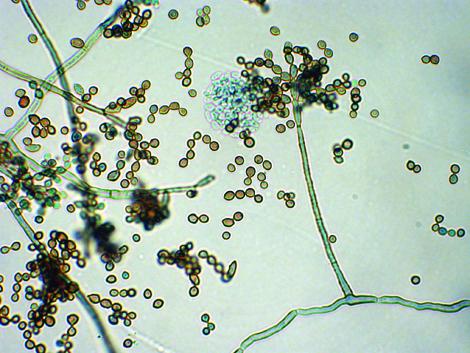
Fonsecaea complex conidiophores and conidia.
de Hoog et al. (2004b) revised the genus on the basis of ITS sequencing data. Three species from humans are currently recognised, F. monophora, F. nubica, and F. pedrosoi, although they are morphologically indistinguishable (Najafzadeh et al. 2009, 2010b; Xi et al. 2009, de Hoog et al. 2015). All strains grow at 37C but not at 40C and the three species are recognised as aetiological agents of chromoblastomycosis.
RG-2 organism.
Morphological description:
Colonies are slow growing, flat to heaped and folded, suede-like to downy, olivaceous to black with black reverse. Conidiogenous cells pale olivaceous, arranged in loosely branched systems, with prominent denticles. Conidia pale olivaceous, clavate to ellipsoidal, in short chains, subhyaline, smooth and thin-walled, 3.5-5 x 1.5-2 µm.
Molecular identification:
ITS sequencing is recommended for species identification (Abliz et al. 2003, Najafzadeh et al. 2009, 2010b, Xi et al. 2009).
| Antifungal susceptibility: Fonsecaea pedrosoi (Australian national data); MIC µg/mL | |||||||||||
|---|---|---|---|---|---|---|---|---|---|---|---|
| No | ≤0.016 | 0.03 | 0.06 | 0.125 | 0.25 | 0.5 | 1 | 2 | 4 | ≥8 | |
| AmB | 11 | 1 | 1 | 5 | 3 | 1 | |||||
| ISAV | 5 | 1 | 2 | 2 | |||||||
| VORI | 11 | 1 | 4 | 5 | 1 | ||||||
| POSA | 11 | 2 | 7 | 2 | |||||||
| ITRA | 11 | 2 | 2 | 7 | |||||||
References:
- Abliz, P., Fukushima, K., Takizawa, K., et al. (2003) Rapid identification of the genus Fonsecaea by PCR with specific oligonucleotide primers. Journal of Clinical Microbiology, 41, 873-876.
- de Hoog, G.S., Adelmann, D., Ahmed, A.O.A., et al. (20040 Phylogeny and typification of Madurella mycetomatis, with a comparison of other agents of eumycetoma. Mycoses, 47, 121-130.
- de Hoog, G.S., Guarro, J., Gene, J., et al. (2015) Atlas of Clinical Fungi (Version 4.1.2). Centraalbureau voor Schimmelcultures, Utrecht, The Netherlands.
- Dixon, D.M. and Polak-Wyss, A. (1991) The medically important dematiaceous fungi and their identification. Mycoses, 34, 1-18.
- McGinnis, M.R. (1980) Laboratory handbook of medical mycology. Academic Press, New York.
- Najafzadeh, M.J., Gueidan, C., Badali, H., et al. (2009) Genetic diversity and species delimitation in the opportunistic genus Fonsecaea. Medical Mycology, 47, 17-25.
- Najafzadeh, M.J., Badali, H., Illnait-Zaragozi, M.T., et al. (2010a) In vitro activities of eight antifungal drugs against 55 clinical isolates of Fonsecaea spp. Journal of Clinical Microbiology, 54, 1636-1638.
- Najafzadeh, M.J., Sun, J., Vicente, V., et al. (2010b) Fonsecaea nubica sp. nov, a new agent of human chromoblastomycosis revealed using molecular data. Medical Mycology, 48, 800-806.
- Xi, L., Sun, J., Lu, C., et al. (2009) Molecular diversity of Fonsecaea (Chaetothyriales) causing chromoblastomycosis in southern China. Medical Mycology, 47, 27-33.