Myrmecridium schulzeri
Synonymy:
Ramichloridium schulzeri
Ramichloridium schulzeri was placed in a new genus, Myrmecridium by Arzanlou et al. (2007).
Myrmecridium schulzeri is an uncommon soil saprophyte of worldwide distribution. It has also been isolated from plant detritus and as a contaminant of bronchoscopy fluid. It is the causative agent of “Golden Tongue” syndrome reported by Rippon et al. (1985).
RG-1 organism.
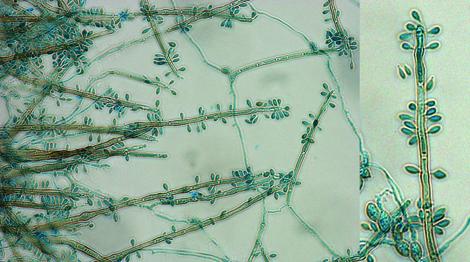
Myrmecridium schulzeri conidiophores showing sympodial development of conidia.
Morphological description:
Colonies growing moderately rapidly, consisting of a rather compact, flat, submerged mycelium, pale orange, locally with some powdery, brownish aerial mycelium; reverse pink to orange. Conidiophores are erect, straight, unbranched, thick-walled, reddish-brown, up to 250 µm high, gradually becoming paler towards the apex, of variable length, elongating sympodially during conidiogenesis, with scattered, pimple-shaped conidium bearing denticles which have unpigmented scars. Conidia are subhyaline, smooth-walled or slightly rough-walled, ellipsoidal, obovoidal or fusiform, 6.5-10 x 3-4 µm, usually with an acuminate base and unpigmented scars.
Molecular identification:
ITS and D1/D2 sequencing may be used for accurate species identification (Halliday et al. 2015).
Note: Myrmecridium species can be distinguished from other Ramichloridium-like fungi by having entirely hyaline vegetative hyphae, and widely scattered, pimple-shaped denticles on the long hyaline rachis. The conidial sheath is also visible in lactic acid mounts with bright field microscopy Arzanlou et al. (2007).
| No | ≤0.016 | 0.03 | 0.06 | 0.125 | 0.25 | 0.5 | 1 | 2 | 4 | ≥8 | |
|---|---|---|---|---|---|---|---|---|---|---|---|
| AmB | 1 | 1 | |||||||||
| VORI | 1 | 1 | |||||||||
| POSA | 1 | 1 | |||||||||
| ITRA | 1 | 1 |
References:
- Arzanlou, M., Groenewald, J.Z., Gams. W., et al. (2007) Phylogenetic and morphotaxonomic revision of Ramichloridium and allied Genera. Studies in Mycology, 58, 57-93.
- de Hoog, G.S. (1977) Rhinocladiella and allied genera. Studies in Mycology, 15, 1-140.
- de Hoog, G.S., Guarro, J., Gene, J., et al. (2015) Atlas of Clinical Fungi (Version 4.1.2). Centraalbureau voor Schimmelcultures, Utrecht, The Netherlands.
- Halliday, C.L., Kidd, S.E., Sorrell, T.C., et al. (2015) Molecular diagnostic methods for invasive fungal disease: the horizon draws nearer? Pathology, 47, 257-269.
- Kidd, S., Halliday, C., Ellis, D. (2023) Descriptions of Medical Fungi (4th edition). CABI.
- Rippon, J.W., Arnow, P.M., Larson, R.A., et. al. (1985) “Golden tongue” syndrome caused by Ramichloridium schulzeri. Archives of Dermatology, 121, 892-894.