Purpureocillium lilacinum
Synonymy:
Paecilomyces lilacinus
Purpureocillium lilacinum is commonly isolated from soil, decaying vegetation, insects, nematodes and as a laboratory contaminant. It is also a causative agent of infection in human and other vertebrates (Luangsa-ard et al. 2011).
Note: Purpureocillium lilacinum and Marquandomyces marquandii were previously classified within the genus Paecilomyces.
RG-1 organism.
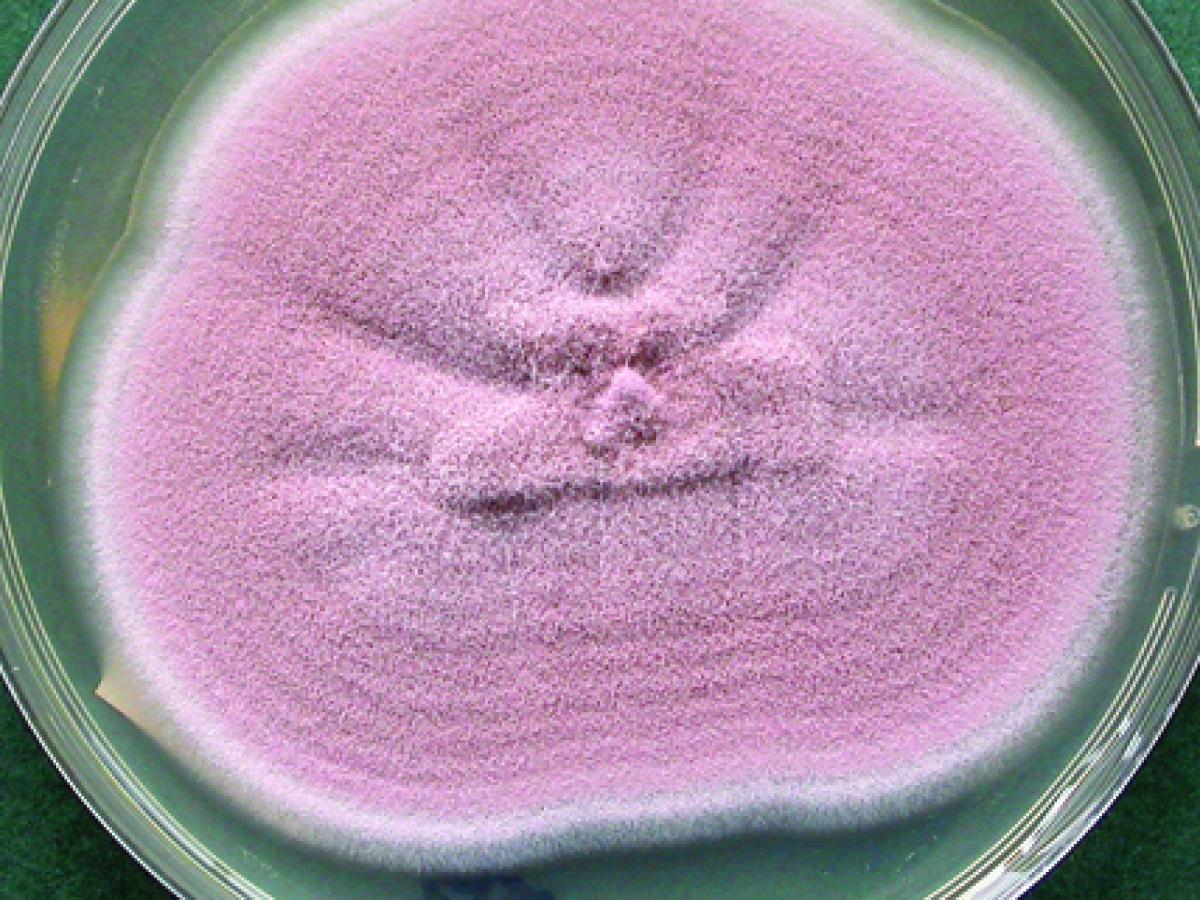
Purpureocillium lilacinum culture.
Morphological description:
Colonies are fast growing, suede-like to floccose, vinaceous to violet-coloured. Conidiophores are erect 400-600 µm in length, bearing branches with densely clustered phialides. Conidiophore stipes are 3-4 µm wide, yellow to purple and rough-walled. Phialides are swollen at their bases, gradually tapering into a slender neck. Conidia are ellipsoidal to fusiform, smooth-walled to slightly roughened, hyaline to purple in mass, 2.5-3.0 x 2-2.2 µm, and are produced in divergent chains. Chlamydospores are absent. Growth at 38C.
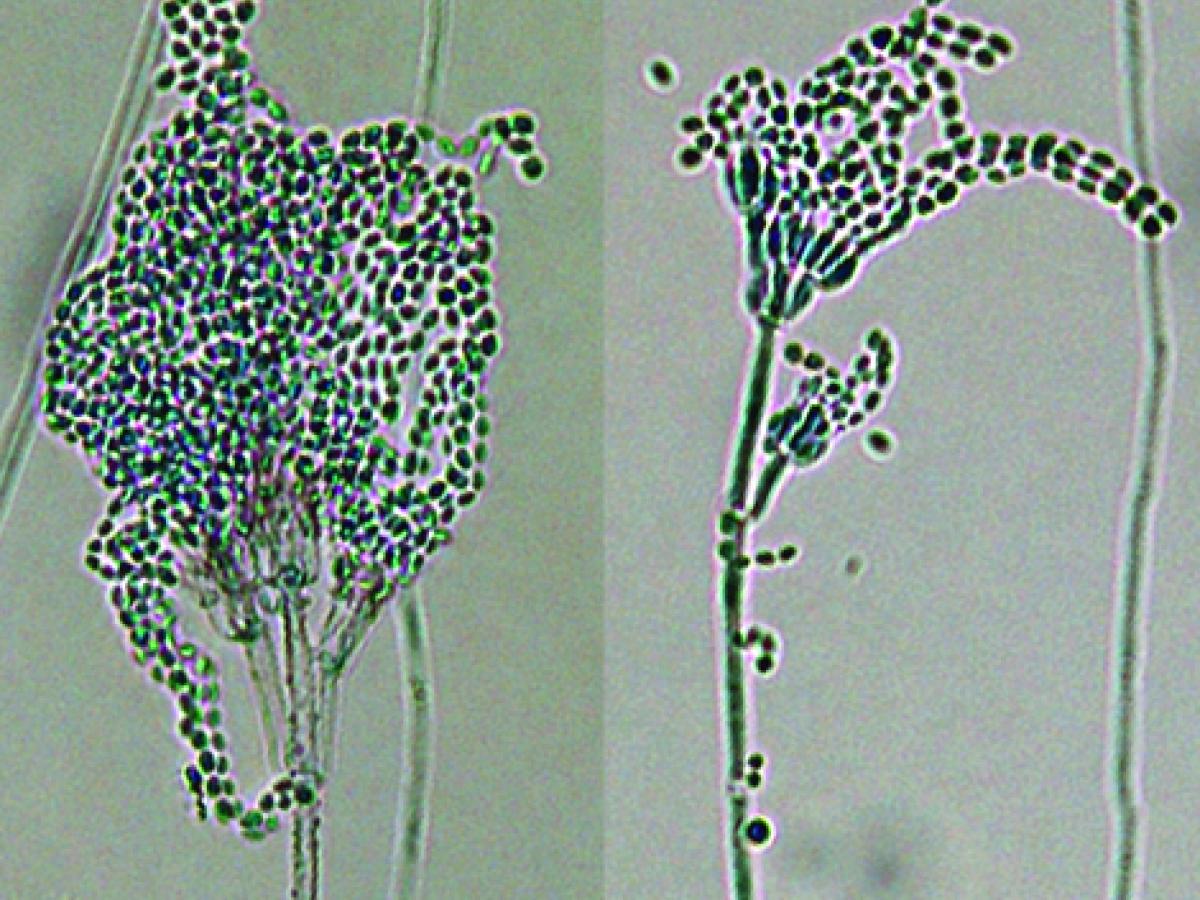
Purpureocillium lilacinum conidiophores, phialides and conidia. Note: Rough-walled conidiophore.
Molecular identification:
ITS sequencing is recommended (Atkins et al. 2005, Luangsa-ard et al. 2011).
Key features:
Colony pigmentation, phialides with swollen bases, pigmented and rough-walled conidiophore stipes, absence of chlamydospores and growth at 37C. Note: Paecilomyces marquandii differs by having a yellow reverse pigment, smooth conidiophore stipes, presence of chlamydospores, and no growth at 37C.
| Antifungal susceptibility: Purpureocillium lilacinum (Australian national data); MIC µg/mL | ||||||||||||
|---|---|---|---|---|---|---|---|---|---|---|---|---|
| No | ≤0.03 | 0.06 | 0.125 | 0.25 | 0.5 | 1 | 2 | 4 | 8 | 16 | ≥32 | |
| AmB | 127 | 1 | 1 | 7 | 8 | 110 | ||||||
| ISAV | 26 | 8 | 16 | 2 | ||||||||
| VORI | 125 | 8 | 65 | 43 | 6 | 2 | 1 | |||||
| POSA | 112 | 8 | 15 | 15 | 62 | 11 | 1 | |||||
| ITRA | 128 | 1 | 1 | 12 | 27 | 51 | 8 | 9 | 4 | 13 | ||
References:
- Atkins, S.D., Clark, I.M., Pande, S., et al. (2005) The use of real-time PCR and species-specific primers for the identification and monitoring of Paecilomyces lilacinus. FEMS Microbiology Ecology, 51, 257-264.
- de Hoog, G.S., Guarro, J., Gene, J., et al. (2015) Atlas of Clinical Fungi (Version 4.1.2). Centraalbureau voor Schimmelcultures, Utrecht, The Netherlands.
- Domsch, K.H., Gams, W. and Anderson, T.H. (2007) Compendium of soil fungi. Second Edition, IHW-Verlag, Germany.
- Kidd, S., Halliday, C., Ellis, D. (2023) Descriptions of Medical Fungi (4th edition). CABI.
- Luangsa-ard, J., Houbraken, J., van Doorn, T., et al. (2011) Purpureocillium, a new genus for the medically important Paecilomyces lilacinus. FEMS Microbiology Letters, 321, 141-149.
- McGinnis, M.R. (1980) Laboratory handbook of medical mycology. Academic Press, New York.
- Onions, A.H.S., Allsopp, D. and. Eggins, H.O.W. (1981) Smith’s introduction to industrial mycology, 7th edition. Edward Arnold, London.
- Perdomo, H., Cano, J., Gene, J., et al. (2013) Polyphasic analysis of Purpureocillium lilacinum isolates from different origins and proposal of the new species Purpureocillium lavendulum. Mycologia, 105, 151-161.
- Rippon, J.W. (1988) Medical mycology: the pathogenic fungi and the pathogenic actinomycetes, 3rd edition. W,B. Saunders Co, Philadelphia, USA.
- Samson, R.A. (1974) Paecilomyces and some allied hyphomycetes. Studies in Mycology, 6, 1-120.