Sepedonium
Sepedonium species are common soil fungi and parasites of fleshy fungi, however Yogo et al. (2014) reported an intra-abdominal infection in an immunosuppressed patient. Sepedonium species closely resemble Histoplasma capsulatum.
Note: For laboratory safety, culture identification to exclude Histoplasma capsulatum should be performed by either exoantigen test or DNA sequencing.
RG-1 organism.
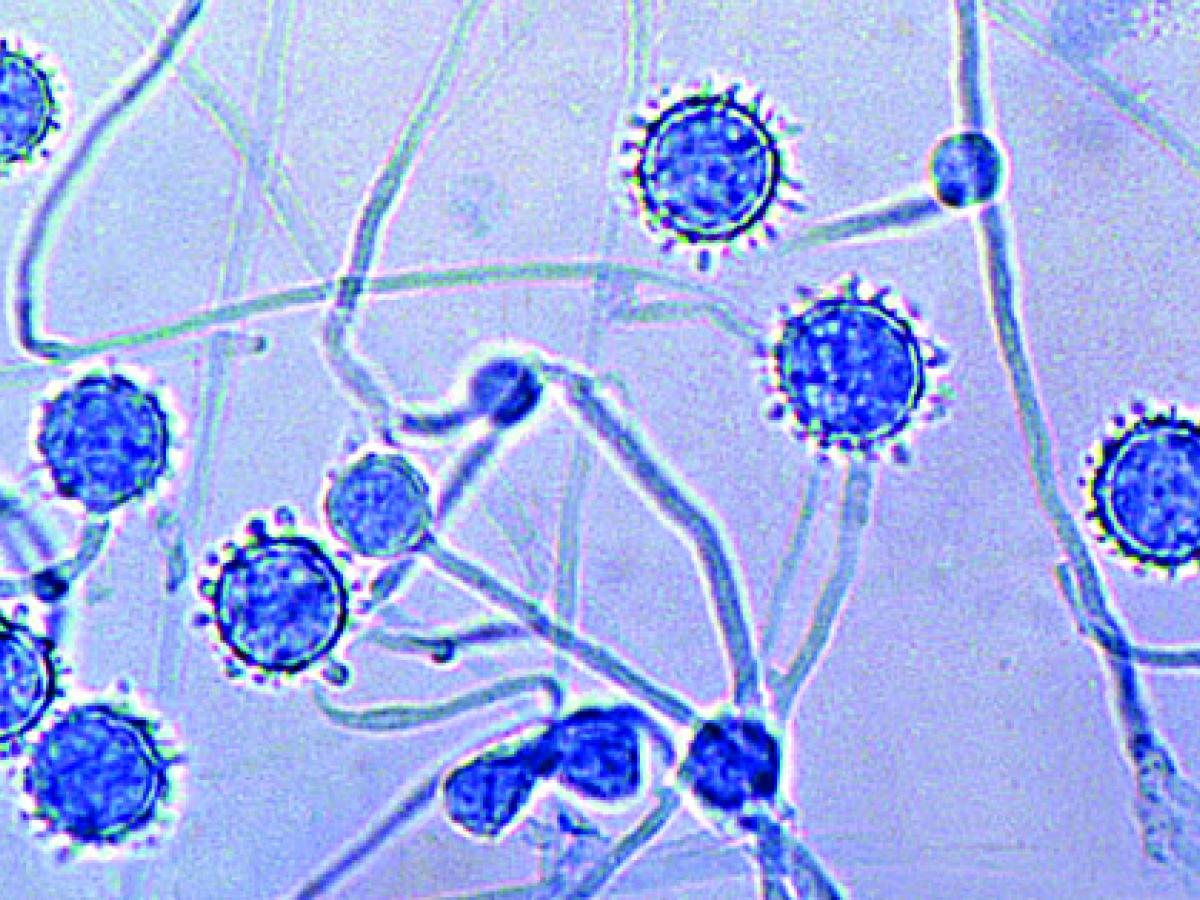
Sepedonium spp. showing large, globose, thick-walled, one-celled, verrucose, terminal conidia.
Morphological description:
Colonies are moderately fast growing, usually white to golden yellow, suede-like to downy, becoming fluffy with age. Conidiophores are hyaline and non-specialised, resembling short branches of the vegetative hyphae. Conidia are terminal, solitary, or in clusters, one-celled, globose to ovoid, 7-17 µm, hyaline to amber, smooth to verrucose and usually with a thick wall.
Key features:
Hyphomycete, producing large, thick-walled, one-celled, verrucose, globose, terminal conidia from non-specialised conidiophores, resembling the macroconidia seen in Histoplasma capsulatum.
Molecular identification:
ITS and D1/D2 sequencing may be used for accurate species identification (Halliday et al. 2015).
References:
- Halliday, C.L., Kidd, S.E., Sorrell, T.C., et al. (2015) Molecular diagnostic methods for invasive fungal disease: the horizon draws nearer? Pathology, 47, 257-269.
- Kidd, S., Halliday, C., Ellis, D. (2023) Descriptions of Medical Fungi (4th edition). CABI.
- McGinnis, M.R. (1980) Laboratory handbook of medical mycology. Academic Press, New York.
- Rippon, J.W. (1988) Medical mycology: the pathogenic fungi and the pathogenic actinomycetes, 3rd edition. W,B. Saunders Co, Philadelphia, USA.
- Yogo, N., Shapiro, L. and Erlandson, K. M. (2014) Sepedonium intra-abdominal infection: a case report and review of an emerging fungal infection. Journal of Antimicrobial Chemotherapy, 69, 2583-1585.