Ulocladium
Species of Ulocladium have now been transferred to the genus Alternaria (Woudenberg et al. 2013). Alternaria should not be confused with other poroconidial genera such as Stemphylium, Bipolaris, Exserohilum, Dreschlera and Curvularia.
A human case of keratitis caused by Alternaria atra (previously Ulocladium atrum) has been reported (Badenoch et al. 2006).
RG-1 organism.
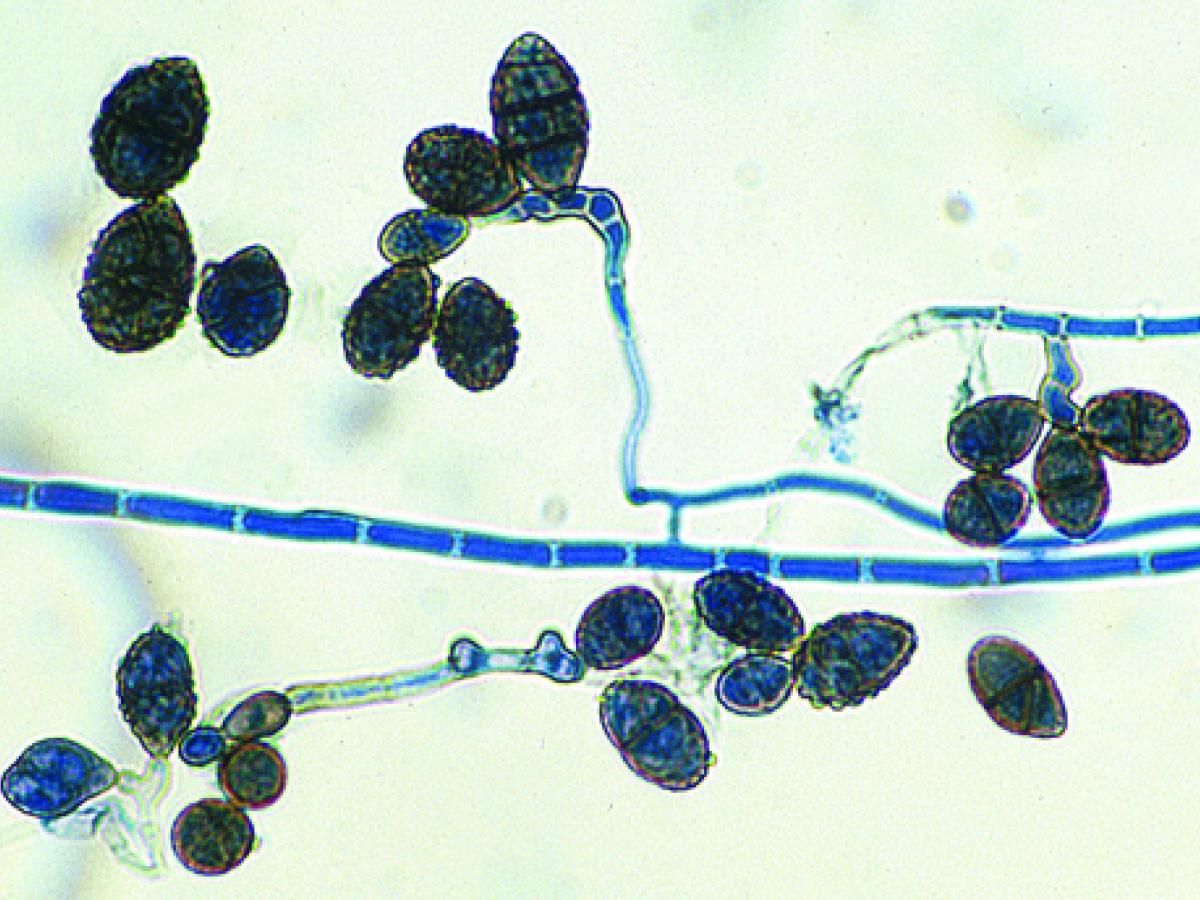
Conidia of Alternaria atra (previously Ulocladium atrum).
Morphological description:
Colonies are rapid growing, brown to olivaceous-black or greyish and suede-like to floccose. Microscopically, numerous, usually solitary, multicelled conidia (dictyoconidia) are formed through a pore (poroconidia) by a sympodially elongating geniculate conidiophore. Conidia are typically obovoid (narrowest at the base), dark brown and often rough-walled. Seven species have been described, all being saprophytes.
Molecular identification:
ITS sequencing is sufficient for genus identification (Badenoch et al. 2006; Woudenberg et al. 2013).
| No | ≤0.016 | 0.03 | 0.06 | 0.125 | 0.25 | 0.5 | 1 | 2 | 4 | ≥8 | |
|---|---|---|---|---|---|---|---|---|---|---|---|
| AmB | 2 | 1 | 1 | ||||||||
| VORI | 2 | 1 | 1 | ||||||||
| POSA | 1 | 1 | |||||||||
| ITRA | 2 | 1 | 1 |
References:
- Badenoch, R.R., Halliday, C.L., Ellis, D.H., et al. (2006) Ulocladium atrum keratitis. Journal of Clinical Microbiology, 44, 1190-1193.
- de Hoog, G.S., Guarro, J., Gene, J., et al. (2015) Atlas of Clinical Fungi (Version 4.1.2). Centraalbureau voor Schimmelcultures, Utrecht, The Netherlands.
- Domsch, K.H., Gams, W. and Anderson, T.H. (2007) Compendium of soil fungi. Second Edition, IHW-Verlag, Germany.
- Ellis, M.B. (1971) Dematiaceous hyphomycetes. Commonwealth Mycological Institute, Kew, Surrey, England.
- Ellis, M.B. (1976) More dematiaceous hyphomycetes. Commonwealth Mycological Institute, Kew, Surrey, England.
- Kidd, S., Halliday, C., Ellis, D. (2023) Descriptions of Medical Fungi (4th edition). CABI.
- Rippon, J.W. (1988) Medical mycology: the pathogenic fungi and the pathogenic actinomycetes, 3rd edition. W,B. Saunders Co, Philadelphia, USA.
- Samson, R.A., Hoekstra, E.S., Frisvad, J.C., et al. (1995) Introduction to food-borne fungi. Centraalbureau voor Schimmelcultures, P.O.Box 273, 3740 AG BAARN, The Netherlands.
- Woudenberg, J.H., Groenewald, J.Z., Binder, M., et al. (2013) Alternaria redefined. Studies in Mycology, 75, 171-212.