Verruconis gallopava
Synonymy:
Ochroconis gallopava
Verruconis species are thermophilic, with Verruconis gallopava occurring in hot environments, such as thermal soils, broiler house litter, hot springs, and self-heated waste (Samerpitak et al. 2014).
Verruconis gallopava is neurotropic and is a recognised agent of human brain infections and is responsible for encephalitis in poultry and wild birds dogs and cats (Seyedmousavi et al. 2014). Occasional human pulmonary infections in immunocompetent hosts have also been reported (Samerpitak et al. 2014, Seyedmousavi et al. 2014, Giraldo et al. 2014).
RG-2 organism.
Morphological description:
Colonies are smooth to suede-like, dry, flat, tobacco-brown to brownish-black with a dark brown diffusible pigment. Hyphae are brown with relatively thick walls. Conidiophores are mostly cylindrical to acicular, sometimes poorly differentiated, bearing a few conidia at the tip. Conidia are two-celled, subhyaline to pale brown, smooth-walled to verrucose, cylindrical to clavate, constricted at the septum, 11-18 x 2.5-4.5 µm in size, with the apical cell wider than the basal cell. A remnant of a denticle may also be seen at the conidial base. Optimum growth at 35C, tolerant to 40C.
Click images below to expand:
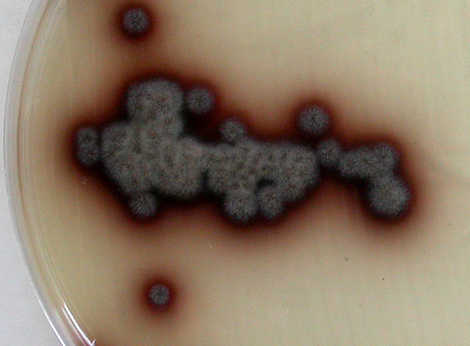
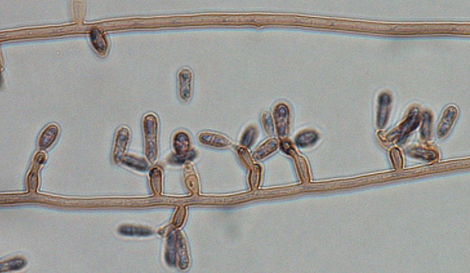
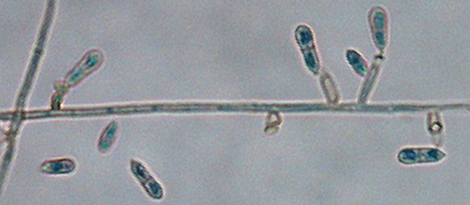
Photos of Verruconis gallopava culture and conidiophores and conidia.
Molecular identification:
ITS sequencing can identify species. Additional genes include β-tubulin, actin, and the D1/D2 region (Giraldo et al.2014, Seyedmousavi et al. 2014).
| No | ≤0.016 | 0.03 | 0.06 | 0.125 | 0.25 | 0.5 | 1 | 2 | 4 | ≥8 | |
|---|---|---|---|---|---|---|---|---|---|---|---|
| AmB | 26 | 1 | 3 | 6 | 11 | 5 | |||||
| ISAV | 6 | 1 | 1 | 4 | |||||||
| VORI | 26 | 2 | 5 | 6 | 7 | 4 | 2 | ||||
| POSA | 25 | 5 | 3 | 8 | 8 | 1 | |||||
| ITRA | 26 | 4 | 4 | 14 | 4 |
References:
- de Hoog, G.S. (1983) On the potentially pathogenic dematiaceous Hyphomycetes. In: Howard, D.H. and Howard, L.F. (eds.) Fungi Pathogenic for Humans and Animals, Marcel Dekker, NY, USA, pp. 149-216.
- Domsch, K.H., Gams, W. and Anderson, T.H. (2007) Compendium of soil fungi. Second Edition, IHW-Verlag, Germany.
- Giraldo, A., Sutton, D.A., Samerpitak, K., et al. (2014) Occurrence of Ochroconis and Verruconis species in clinical specimens from the United States. Journal of Clinical Microbiology, 52, 4189-4201.
- Kidd, S., Halliday, C., Ellis, D. (2023) Descriptions of Medical Fungi (4th edition). CABI.
- McGinnis, M.R. (1980) Laboratory handbook of medical mycology. Academic Press, New York.
- Samerpitak, K., van der Linde, E., Choi, H.-J., et al. (2014) Taxonomy of Ochroconis, genus including opportunistic pathogens on humans and animals. Fungal Diversity, 65, 89-126.
- Seyedmousavi, S., Samerpitak, K., Rijs, A.J.M.M., et al. (2014) Antifungal susceptibility patterns of opportunistic fungi in the genera Verruconis and Ochroconis. Antimicrobial Agents and Chemotherapy, 58, 3285-3292.