Lomentospora prolificans
Synonymy:
Scedosporium prolificans; Scedosporium inflatum.
Lomentospora prolificans (formerly Scedosporium prolificans) is phylogenetically and morphologically distinguishable from Scedosporium species (Lennon et al. 1994, Lackner et al. 2014).
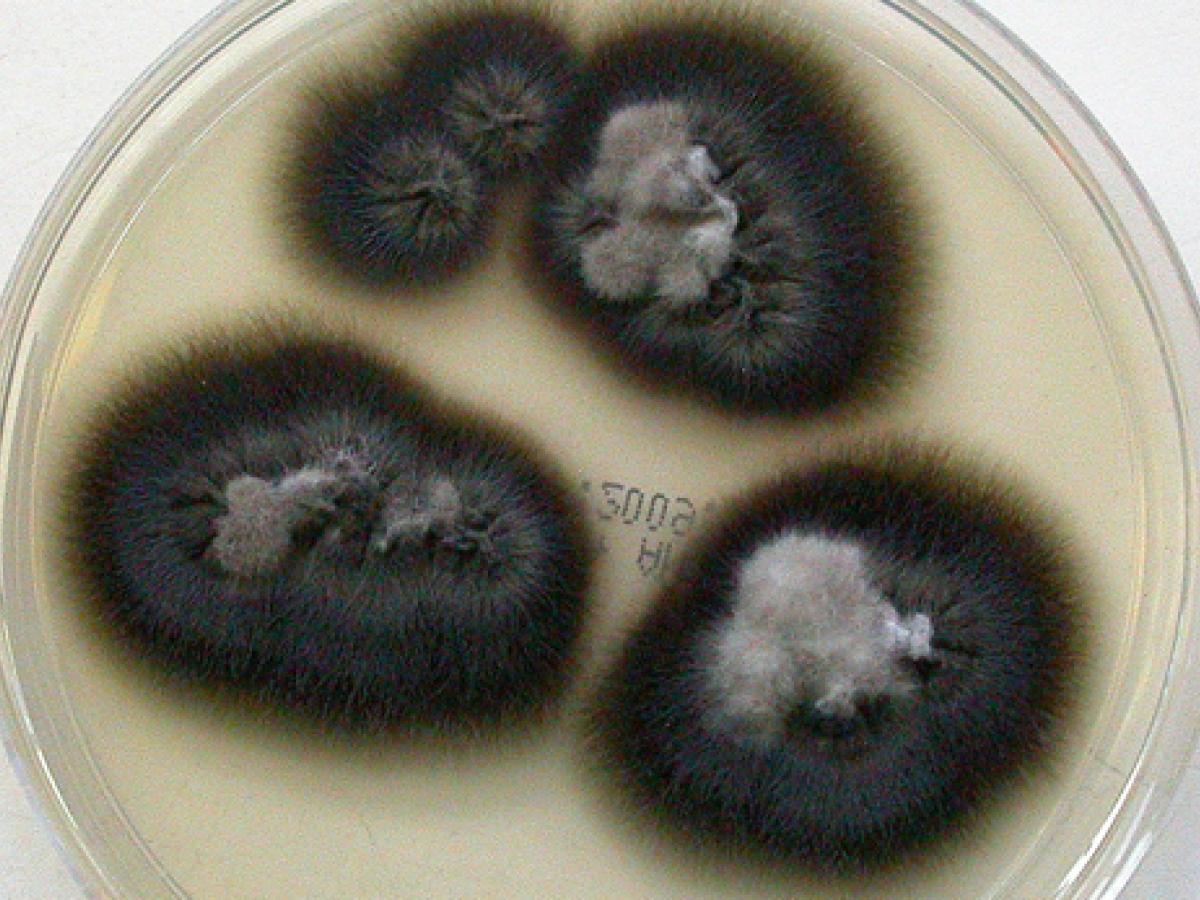
Lomentospora prolificans culture.
Lomentospora prolificans appears to occupy a restricted geographic range, with infections occurring mainly in Australia, Spain, and the United States (Heath et al. 2009, Revankar and Sutton, 2010). L. prolificans infections are refractory to antifungal therapy and are associated with high mortality. Major risk factors include malignancy, cystic fibrosis, and solid organ transplantation. The main clinical presentations are disseminated infection and pulmonary mycoses, followed by bone and joint infections (Cortez et al. 2008, Heath et al. 2009, Rodriguez-Tudela et al. 2009, Revankar and Sutton, 2010).
RG-2 organism.
Morphological description:
Colonies are rapid growing, flat, spreading, olive-grey to black and have a suede-like to downy surface texture. Conidia are borne in small groups on distinctive basally swollen, flask-shaped conidiophores, which occur singly or in clusters along the vegetative hyphae. Conidia are aggregated in slimy heads, single-celled, hyaline to pale-brown, ovoid to pyriform, 3-7 x 2-5 µm, and have smooth thick walls. Growth at 45C.
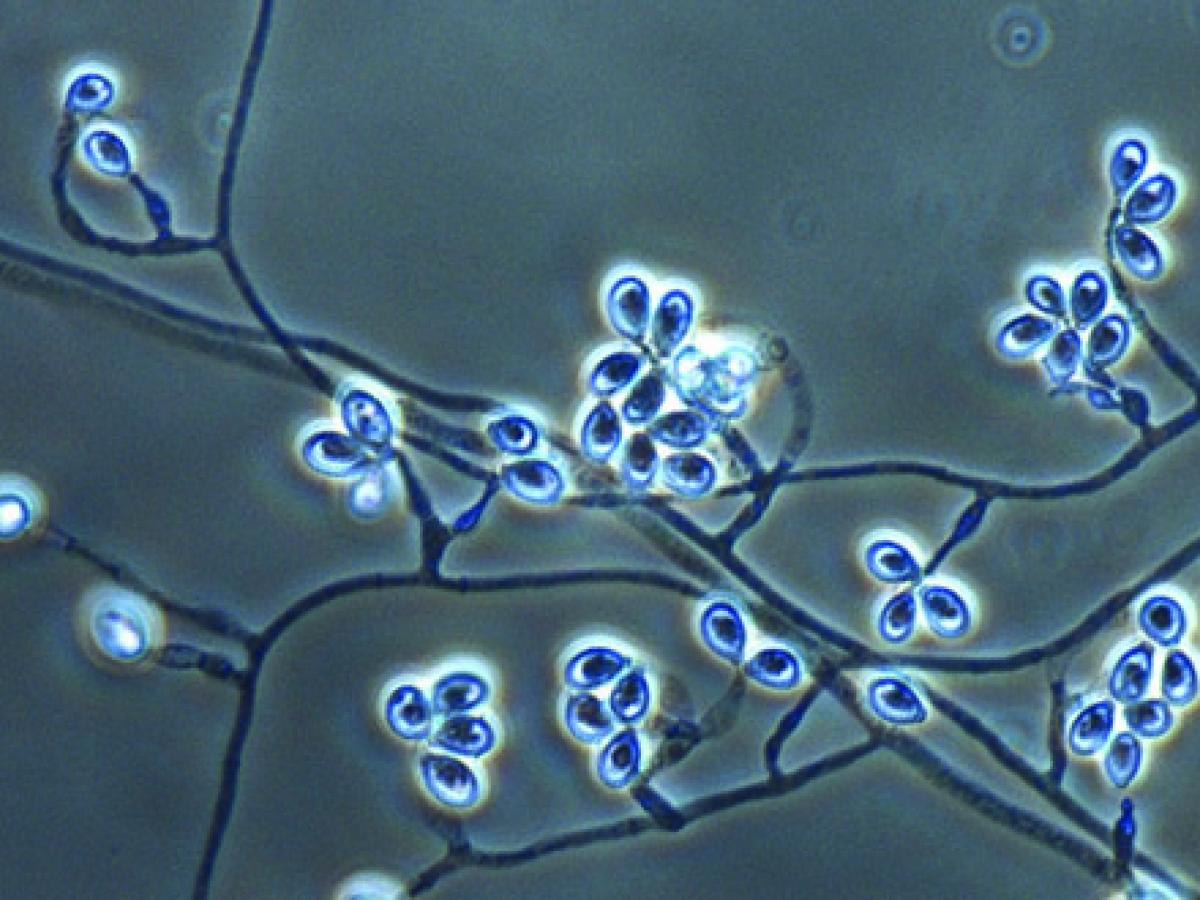
Lomentospora prolificans conidiophores and conidia.
Key features:
Dematiaceous hyphomycete with initial black pasty colony, conidiophores with distinctly swollen bases, and the conidial mass forms apical aggregates of conidia. A Graphium synanamorph is absent and there is no growth on media containing cycloheximide (actidione).
Molecular identification:
Recommended genetic markers: ITS and β-tubulin.
| Antifungal susceptibility: Lomentospora prolificans (Australian national data); MIC µg/mL | ||||||||||||
|---|---|---|---|---|---|---|---|---|---|---|---|---|
| No | <0.03 | 0.06 | 0.125 | 0.25 | 0.5 | 1 | 2 | 4 | 8 | 16 | >32 | |
| AmB | 460 | 1 | 2 | 14 | 62 | 351 | 30 | |||||
| ISAV | 119 | 5 | 12 | 102 | ||||||||
| VORI | 455 | 6 | 34 | 75 | 340 | |||||||
| POSA | 376 | 1 | 1 | 374 | ||||||||
| ITRA | 463 | 2 | 458 | 3 | ||||||||
| Synergy testing results for Lomentospora prolificans (Australian national data). | |||||||||||
|---|---|---|---|---|---|---|---|---|---|---|---|
| Antifungal Combination | No | ∑FIC < 0.5 (S) | ∑FIC < 0.5-4 (I) | ∑FIC > 4 (A) | |||||||
| VORI/TERB | 109 | 94 (86%) | 14 (14%) | 0 | |||||||
| ITRA/TERB | 93 | 56 (60%) | 37 (40%) | 0 | |||||||
References:
- Cortez, K.J., Roilides, E., Quiroz-Telles, F., et al. (2008) Infections caused by Scedosporium spp. Clinical Microbiology Reviews, 21, 157-197de Hoog, G.S., Guarro, J., Gene, J., et al. (2015) Atlas of Clinical Fungi (Version 4.1.2). Centraalbureau voor Schimmelcultures, Utrecht, The Netherlands.
- Gilgado, F., Cano, J., Gene, J., et al. (2005) Molecular phylogeny of the Pseudallescheria boydii species complex: proposal of two new species. Journal of Clinical Microbiology, 43, 4930-4942.
- Guarro, J., Kantarcioglus, A.S., Horre, R., et al. (2006) Scedosporium apiospermum: changing clinical spectrum of a therapy-refractory opportunist. Medical Mycology, 44, 295-327.
- Heath, C.H., Slavin, M. A., Sorrell, T.C., et al. (2009). Population-based surveillance for scedosporiosis in Australia: epidemiology, disease manifestations and emergence of Scedosporium aurantiacum infection. Clinical Microbiology and Infection, 15, 689-693.
- Kidd, S., Halliday, C., Ellis, D. (2023) Descriptions of Medical Fungi (4th edition). CABI.
- Lackner, M., de Hoog, G.S., Yang, L., et al. (2014) Proposed nomenclature for Pseudallescheria, Scedosporium and related genera. Fungal Diversity, 67, 1-10.
- Lennon, P.A., Cooper, C.R. Jr., Salkin, I.F., et al. (1994) Ribosomal DNA internal transcribed spacer analysis supports synonymy of Scedosporium inflatum and Lomentospora prolificans. Journal of Clinical Microbiology, 32, 2413-2416.
- Malloch, D. and Salkin, I.F. (1984) A new species of Scedosporium associated with osteomyelitis in humans. Mycotaxon, 21, 247-255.
- Rainer, J. and de Hoog, G.S. (2006) Molecular taxonomy and ecology of Pseudallescheria, Petriella and Scedosporium prolificans (Microascaceae) containing opportunistic agents on humans. Mycological Research, 110, 151-160.
- Rippon, J.W. (1988) Medical mycology: the pathogenic fungi and the pathogenic actinomycetes, 3rd edition. W,B. Saunders Co, Philadelphia, USA.
- Revankar, S.G. and Sutton, D.A. (2010) Melanized fungi in human disease. Clinical Microbiology Reviews, 23, 884-928.
- Rodriguez-Tudela, J.L., Berenguer, J., Guarro, J., et al. (2009) Epidemiology and outcome of Scedosporium prolificans infection, a review of 162 cases. Medical Mycology, 47, 359-370.
- Salkin, I.F., McGinnis, M.R., Dykstra M.J. and Rinaldi, M.G. (1988) Scedosporium inflatum, an emerging pathogen. Journal Clinical Microbiology, 26, 498-503.
- Sleiman, S., Halliday, C.L., Chapman, B., et al. (2016) Performance of matrix-assisted laser desorption ionization-time of flight mass spectrometry for identification of Aspergillus, Scedosporium, and Fusariumspp. in the Australian clinical setting. Journal of Clinical Microbiology, 54, 2182–2186.
- Wilson, C.M., O’Rourke, E.J., McGinnis, M.R., et. al. (1990) Scedosporium inflatum: Clinical spectrum of a newly recognised pathogen. Journal of Infectious Diseases, 161, 102-107.